AVF Needle Side Holes And Laser Grooving
Jun 30, 2026
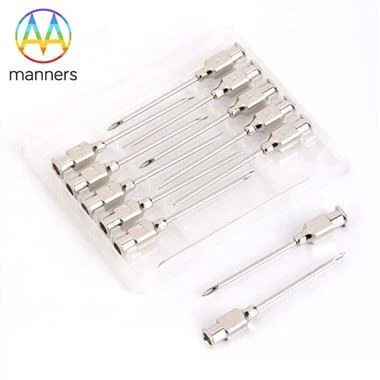
During hemodialysis, AVF needles must sustain 200–400 mL/min blood flow - one needle (arterial) draws, one (venous) returns, both typically 17G. Manners' specification gives OD 1.45 mm / ID 1.19 mm / 17G / length 23.84 mm. Per Poiseuille's Law, a single-orifice needle at 300 mL/min has an internal flow velocity of ~4.7 m/s, with local resistance at the inlet (needle tip orifice) accounting for >60% of total pressure drop. This is why "standard single-hole AVF needles" on high-output fistulas (>800 mL/min native or graft fistulas) are prone to "wall suction + flow fluctuation" - blood cells adhere to the inner inlet, momentarily dropping flow below 150 mL/min and triggering dialysis machine alarms.
Fluid Significance of Side Holes
Opening 2–3 side holes (Ø0.3–0.5 mm) 3–5 mm proximal to the needle tip increases effective inlet cross-sectional area by 30–50% and reduces local inlet resistance by 20–35%. However, more holes are not always better: side holes too close to the bevel can be occluded when the shaft contacts the opposite intima; side holes too far back cause the tip section to "float" in the lumen and wobble. Manners uses 5-axis lasers for "custom AVF needles with additional side holes" - the 5-axis capability is critical because the needle is cylindrical; a 2D laser only cuts aligned holes, whereas side holes require "needle rotation + laser head tilting" to create a 15–20° inflow angle, letting blood enter obliquely rather than hitting the wall at 90°.
The Other Purpose of Laser Grooving
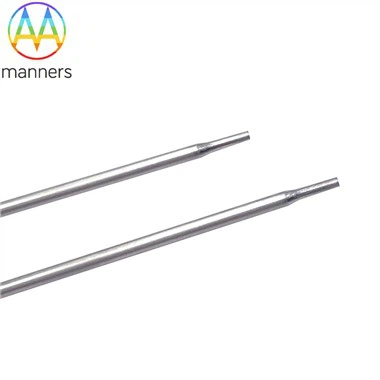
The "grooves made using advanced 5-axis laser" mentioned are not decorative. Two to three longitudinal micro-grooves (depth 0.01–0.02 mm, width 0.05–0.08 mm) on the outer needle surface can retain minute amounts of interstitial fluid during insertion, reducing friction between needle shaft and vessel wall. Upon withdrawal, the grooves create slight negative capillary action that may marginally reduce track oozing. More critically: if groove positions are staggered from side holes, stress concentration around the side-hole corners (a stress riser on a 0.13 mm wall) is partially dissipated by the grooves. Without grooving, repeated bending (when nurses fix the wing handle) can cause micro-cracks at side-hole edges, worsening track bleeding in heparinized patients.
The Precision Account: Why ±0.01 mm Costs More on AVF Than Hypodermic
The source material states "5-axis laser general tolerance ±0.05–0.1 mm, medical application tight as ±0.01 mm." A 25G hypodermic needle has a 0.08 mm wall - side holes aren't even feasible. An AVF 17G has a 0.13 mm wall, and a Ø0.4 mm side hole leaves only 0.04–0.05 mm residual wall on each side - a 5% laser power deviation causes burn-through. Thus, ±0.01 mm for AVF isn't "medical marketing fluff"; it's the survival line for not perforating the wall. This is also why the 5-axis laser process step for AVF needles costs 40–60% more per piece than the same-length hypodermic laser step: each needle requires "rotary encoding + Z-axis laser linkage + real-time power闭环 (closed-loop control)," with a cycle time 3× slower than ordinary laser marking.
For Manufacturing: Don't just write "17G, 300 mL/min rated" for AVF flow specs. Brand owners now want a CFD report: "Inlet pressure drop curves for single-hole vs. 2-side-hole vs. 3-side-hole." Whoever can attach this graph wins the high-end order.