Application Of Echogenic Needles In Emergency Trauma Analgesia And Nerve Block
Aug 13, 2026
https://www.nature.com/articles/s41598-024-72620-8
1. Clinical Pain Points
Emergency trauma patients such as limb fracture, soft tissue avulsion and joint dislocation often suffer from severe acute pain, requiring rapid and effective nerve block analgesia. However, emergency clinical scenarios have prominent limitations: patients have unstable vital signs, obvious limb swelling and tissue displacement after trauma, resulting in blurred ultrasound imaging of nerves and difficult identification of normal anatomical structure. Traditional ordinary needles have poor visualization effect, and blind puncture is highly likely to cause secondary injury to fractured tissues and blood vessels. Moreover, emergency operation requires rapid and efficient anesthesia, while traditional single guidance technology has slow positioning speed, low one-time success rate, and cannot meet the rapid analgesia demand of emergency trauma. In addition, excessive reliance on opioid analgesics in traditional emergency treatment is easy to cause adverse reactions such as respiratory depression and dizziness, with low safety and poor patient tolerance.
2. Working Principle of Echogenic Nerve Block Needles
Echogenic nerve block needles are highly adapted to emergency trauma scenarios with their dual-core positioning advantages. The high-precision laser echo marking technology enables the needle body to present stable high-brightness imaging in swollen and distorted traumatic tissues, effectively resisting the imaging interference caused by tissue edema and blood stasis, and realizing real-time clear identification of needle trajectory. The electrical nerve stimulation system can quickly capture the bioelectrical signals of target nerves. Even if the anatomical structure is distorted after trauma, it can accurately judge the relative position of the needle tip and the nerve through nerve reflex and muscle contraction response, avoiding positioning errors caused by structural displacement. The dual verification mechanism of vision and electrical signals greatly improves the anti-interference ability of puncture operation, realizes rapid and accurate positioning in complex emergency traumatic tissues, and completes efficient nerve block analgesia in a short time.
3. Equipment Classification and Adaptive Scenarios
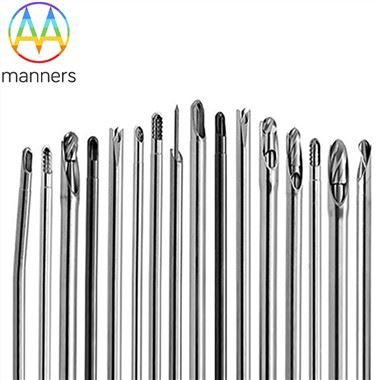
According to emergency trauma types and operation timeliness requirements, echogenic needles are divided into rapid emergency puncture type and anti-edema enhanced type. The conventional rapid puncture echogenic needles (20G-24G) are suitable for routine emergency limb fracture dislocation analgesia, with fast puncture speed and stable basic echo performance, meeting the rapid treatment needs of most mild and moderate trauma patients. The anti-edema enhanced echogenic needles (18G-22G) adopt optimized surface echo structure, which can maintain excellent imaging effect in edema and hematic stasis tissues, and are specially used for severe trauma with obvious limb swelling and anatomical distortion. All emergency special needles adopt integrated sterile packaging, supporting rapid opening and use, adapting to the efficient and fast-paced operation mode of emergency department.
4. Standard Operational Guidelines
For emergency trauma patients, first complete vital sign monitoring and wound preliminary hemostasis treatment, quickly judge the trauma site and nerve block range, and select the matched echogenic needle specification. Rapidly debug the ultrasound instrument, adjust the probe frequency according to the tissue swelling degree, and quickly locate the general running direction of the target nerve. Adopt rapid in-plane puncture technique, advance the needle quickly and stably, observe the needle entry track in real time through ultrasound, and start the nerve stimulation device for auxiliary verification. After confirming that the needle tip is close to the target nerve and no abnormal vascular puncture, inject low-dose local anesthetic rapidly and evenly. Real-time observe the drug diffusion and nerve block effect, complete rapid analgesia, and avoid excessive operation time affecting subsequent trauma treatment.
5. Practical Clinical Experience
In emergency trauma clinical practice, echogenic nerve block needles have greatly improved the efficiency and safety of emergency analgesia. Compared with traditional technology, the positioning time of nerve block is shortened by more than 40%, and the one-time puncture success rate is increased from 70% to 95%, which effectively avoids secondary tissue injury caused by repeated puncture for trauma patients. The dual-mode positioning technology can accurately complete nerve block under the condition of limb swelling and anatomical distortion, solving the difficult problem of difficult positioning of traumatic distorted nerves. Clinical statistics show that the application of echogenic needle nerve block reduces the use of opioid analgesics in emergency trauma patients by 60%, significantly reducing the incidence of respiratory depression, nausea and other adverse reactions. Meanwhile, the rapid analgesia effect stabilizes the patient's vital signs and creates good conditions for subsequent surgical debridement and fracture reduction.
6. Summary and sublimation
Emergency trauma analgesia has the core requirements of rapidity, accuracy and safety, and the complex and variable clinical environment has always restricted the effect of traditional nerve block technology. The poor visualization and low anti-interference ability of traditional puncture tools lead to low efficiency and high risk of emergency analgesia. Echogenic nerve block needles adapt to the complex environment of trauma tissues through optimized echo enhancement structure and dual intelligent positioning technology, realize rapid and accurate nerve block analgesia, reduce the dependence on opioid drugs, and reduce the risk of adverse reactions. It provides a safe and efficient new analgesia scheme for emergency trauma treatment, and greatly improves the overall emergency treatment level.
7. Future Application Prospects and Suggestions
Emergency trauma treatment is developing towards precision and minimal invasion, and the popularization of high-efficiency nerve block analgesia technology is an inevitable trend. It is suggested that emergency departments fully promote the application of echogenic nerve block needles, formulate emergency rapid operation guidelines suitable for different trauma types, and improve the standardized operation ability of emergency clinicians. Product side can further develop portable emergency special echogenic needles, optimize the rapid puncture performance and anti-edema imaging ability. At the same time, carry out multi-center clinical research to summarize the optimal analgesia scheme for different emergency traumas, and expand the application scope in pre-hospital emergency analgesia and mass casualty rescue scenarios.