Anti-Kink Performance Of RF Ablation Needle
Sep 18, 2026
1. Industry Pain Points
Insufficient anti-kink performance is a common failure problem of traditional RF ablation needles in complex minimally invasive ablation scenarios. In clinical operations such as deep visceral tumor ablation, tortuous tissue channel puncture and multi-angle adjustable ablation, traditional ablation needles are prone to local folding, tube body kink and lumen collapse under tissue extrusion and bending stress. Once kink deformation occurs, the needle shaft will have blocked energy conduction, deflected ablation direction and failed normal working function, resulting in forced surgical interruption. For peripheral vascular, neurological and thoracic and abdominal complex lesion ablation, the narrow and tortuous tissue environment greatly increases the kink failure rate of traditional needles. In addition, kink deformation will cause irreversible structural damage to the needle shaft, produce sharp structural edges, and easily scratch surrounding normal tissues and blood vessels during withdrawal, bringing serious surgical safety hazards and increasing patient trauma and operation cost.
2. Working Principle
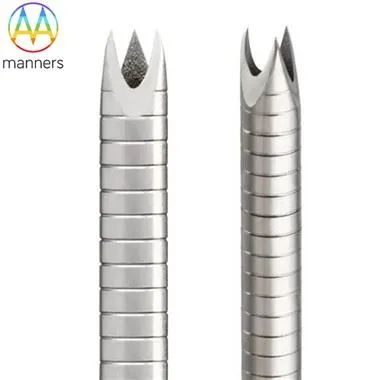
The excellent anti-kink performance of modern laser-cut RF ablation needles is based on stress buffer structural design and high-toughness alloy material characteristics. Supported by 0.012mm ultra-fine kerf laser precision cutting technology, ordered flexible buffer gaps are processed on the 0.20mm–20mm medical hypotube shaft. When the needle body is bent and extruded in complex tissue channels, the regular deformation of laser cutting gaps disperses local concentrated stress, avoiding tube wall folding and lumen collapse caused by excessive stress accumulation. The integral continuous metal framework retained by laser cutting ensures the basic axial support rigidity of the needle shaft, realizing the perfect balance of flexible bending adaptation and rigid anti-kink capability. High-toughness medical materials including Nitinol, 316L stainless steel and L605 alloy have excellent elastic recovery performance, which can quickly restore the original linear structure after bending deformation without residual kink deformation. Different laser cutting pattern densities realize graded anti-kink performance to adapt to different surgical bending frequencies and tissue extrusion environments.
3. Anti-Kink Performance Classification
According to bending resistance and scenario adaptation, RF ablation needles are divided into four anti-kink types. First, full-range spiral anti-kink needles: continuous spiral buffer gaps, full-stress dispersion, suitable for multi-angle frequent bending ablation of superficial tissues. Second, segmented reinforced anti-kink needles: dense buffer structure at vulnerable bending segments, strong local anti-collapse ability, ideal for deep complex tissue channel ablation. Third, radial buffer anti-kink needles: symmetrical radial gaps, uniform omnidirectional stress resistance, dedicated for narrow ultra-tortuous lumen and tissue channel ablation. Fourth, high-fatigue anti-kink needles: high-toughness alloy material + optimized gap density, resistant to long-term cyclic bending, suitable for multi-point continuous batch ablation surgery.
4. Practical Application Guidelines
Select targeted anti-kink ablation needles according to tissue channel complexity and bending frequency. For narrow tortuous tissue channel ablation, prioritize radial buffer anti-kink needles to resist omnidirectional extrusion deformation. For deep complex lesion multi-angle adjustment ablation, adopt segmented reinforced anti-kink needles to protect key bending segments. During operation, avoid excessive single-angle bending and violent tissue extrusion; adjust the needle angle gently and step by step to release structural stress in real time. When passing through tortuous tissue channels, cooperate slow propulsion and micro-angle adjustment to prevent local stress accumulation and kink deformation. After surgery, check the needle body elastic recovery state, and replace products with residual deformation in time.
5. Practical Industry Experience
Clinical scenario verification shows that laser-optimized anti-kink RF ablation needles reduce intraoperative kink failure rate by 54% compared with traditional products. The buffer stress dispersion structure completely solves the kink and collapse problems of needles in narrow tortuous tissue channels, improving surgical continuous operation rate by 39%. High-toughness alloy needles can withstand more than 1200 times of cyclic bending without structural kink and residual deformation, with excellent fatigue resistance. All products have stable anti-kink performance and structural safety in complex ablation scenarios, effectively avoiding surgical interruption and secondary tissue injury caused by needle deformation, and improving clinical surgical efficiency and safety.
6. Summary & Enhancement
Anti-kink performance is the key safety guarantee for continuous and stable operation of RF ablation needles in complex tissue environments. Traditional single-structure ablation needles have performance contradictions between rigidity and flexibility, leading to high kink failure rate in complex bending scenarios. Laser buffer structural design fundamentally breaks through the performance limitation, realizing organic integration of tissue bending adaptability and structural anti-collapse capability. Classified anti-kink products can accurately match different complex ablation scenarios and solve key clinical safety pain points. At present, conventional anti-kink performance is mature, but the extreme anti-fatigue kink resistance under long-term continuous operation still needs further optimization.
7. Future Development Suggestions
Future anti-kink performance upgrading of RF ablation needles will focus on bionic adaptive buffer structure and extreme fatigue resistance optimization. Develop bionic tissue-adaptive gradient buffer structures to realize automatic stress adjustment for different bending angles and extrusion forces. Optimize new high-toughness composite alloy materials to improve long-term cyclic bending anti-kink capability of needles. Establish anti-kink performance grading standards corresponding to surgical complexity to refine product selection specifications. Iterate laser pattern parameters through finite element stress simulation to further improve the extreme anti-kink stability of RF ablation needles in ultra-complex minimally invasive ablation scenarios.