Analysis Of Diamond Tip Puncture Technology Principle And Manufacturers’ Precision Forming Process
Jul 27, 2026
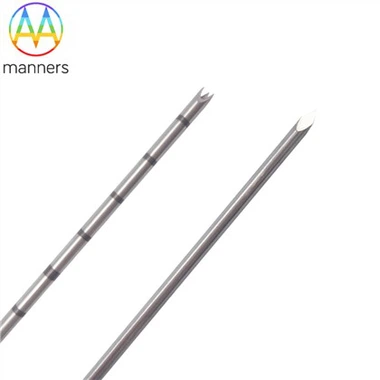
Diamond tip bone marrow biopsy needles represent an upgraded alternative to conventional bone marrow puncture instruments, with their core competitive advantage embodied in the trocar diamond tip structure, a landmark innovation for high-end minimally invasive biopsy devices. Within the medical device industry, traditional bone marrow biopsy needles mostly adopt simple bevel tips. When puncturing hard cortical bone, such tips generate high resistance, easily squeeze bone tissue, and suffer premature blunting. These defects frequently lead to severe patient pain, distorted tissue specimens and repeated failed punctures. Qualified manufacturers leverage precision moulds and CNC machining to develop the diamond tip structure, effectively resolving longstanding pain points of traditional tips and making this product a preferred option for advanced bone marrow biopsy procedures.
From a technical perspective, the diamond tip features a multi-faceted pyramidal cutting geometry, differing from the unidirectional cutting mode of single-bevel tips. It enables uniform multi-angle osteotomy and layered penetration. Human cortical bone is dense and rigid. Conventional tips tend to slip and deviate during puncture, requiring heavy operator force that may damage surrounding soft tissue and periosteum. The optimized trocar diamond tip manufactured by professional suppliers delivers symmetrical sharp cutting edges for even force distribution and excellent directional stability. It rapidly penetrates hard cortical bone with drastically reduced puncture resistance to achieve fast, precise minimally invasive access. This design avoids bone cracking and tissue contusion, lowering intraoperative pain as well as postoperative swelling and bleeding risks. It is suitable for patients with complex bone conditions including osteosclerosis, senile osteoporosis and myelofibrosis.
In terms of production, diamond tips impose extremely high precision requirements on manufacturers and involve sophisticated precision medical machining. Basic fine grinding suffices for ordinary tips, while diamond tip fabrication requires three integrated processes: five-axis CNC grinding, laser trimming and micro-radian calibration. Manufacturers accurately replicate standard pyramidal tapers and symmetrical cutting edges to guarantee consistent sharpness, angles and tapers across every needle. The complete workflow covers necking, swaging, precision grinding, laser cutting and electropolishing. While delivering exceptional tip sharpness, the processes retain the structural integrity of medical stainless steel to prevent chipping and abrasion, striking an optimal balance between sharpness and durability.
Under industrial quality control standards, diamond tips must pass three critical inspections: puncture fatigue testing, sharpness verification and angular deviation detection. Reputable manufacturers implement exclusive tip quality control protocols, conducting full visual inspection of each batch alongside sampling mechanical testing. All multi-faceted edges must be free of burrs and notches with symmetrical angles to eliminate puncture deviation, tissue destruction and unqualified sampling caused by inadequate tip precision. Combined with electropolishing, the tip achieves mirror surface smoothness without residual metal debris, fully complying with safety standards for sterile invasive medical devices.
Compared with traditional alternatives, diamond tip biopsy needles developed by professional manufacturers achieve over 40% improvement in puncture efficiency, significantly raise the one-pass sampling success rate and enhance minimally invasive patient experience. Currently, this tip technology is compatible with all specifications ranging from 8G to 18G and supports customized tip angle adjustments to cover clinical demands for adults, paediatric patients and individuals with complicated bone lesions. It stands as a benchmark for technological upgrading within the bone marrow biopsy instrument sector and constitutes a core technical competitive advantage for high-end medical device manufacturers.