AI-Assisted Brachytherapy Needle Treatment Planning
Nov 27, 2026
Treatment planning in brachytherapy has always been a negotiation between what the dosimetry wants and what the needle can physically deliver. A physicist can generate an elegant dose distribution in minutes, but translating that distribution into a set of straight tracks through a deforming gland, around a urethra, and past a pubic arch is where plans meet reality. AI-assisted planning attacks exactly that translation step. For the implant team, this changes the specification of the hardware: a brachytherapy needle for cancer treatment that must execute an algorithm's output needs tolerances tighter than those required by a human-drawn plan, because automated plans tend to push constraints closer to their limits.
Why Manual Planning Bottlenecks Implant Quality
Conventional planning is iterative and slow. The planner contours the target and organs at risk, proposes a seed distribution, evaluates dose-volume metrics, adjusts, and repeats. Each cycle consumes physicist time, and in a busy department the number of cycles is limited by the schedule rather than by what the plan could achieve. The practical result is that plans converge on a familiar, acceptable solution rather than an optimized one.
Manual planning also carries variability between planners. Two physicists may produce plans with meaningfully different urethral doses for the same patient, and the difference is rarely attributable to a deliberate clinical choice. In focal and dose-escalated strategies, where the therapeutic window is narrower, this variability becomes clinically relevant.
Finally, manual planning struggles with multi-objective trade-offs. Coverage, urethral dose, rectal dose, and track count compete, and a human planner must resolve that competition case by case. AI-assisted planning reframes the problem as a formal optimization with explicit objectives, which makes the trade-offs visible and reproducible - but it also means the plan may demand track placements that only a well-controlled needle can achieve.
What the Algorithm Actually Computes
Modern AI-assisted brachytherapy planning combines two layers. The first is deep-learning-based segmentation and prediction: convolutional or transformer networks contour the prostate, urethra, rectum, and often the dominant lesion on ultrasound or MRI, and some models predict achievable dose distributions directly from imaging, providing a starting point that is already close to feasible. The second is optimization: dose-volume objectives are encoded as an objective function, and search methods - simulated annealing, mixed-integer programming, or learned policies - select seed positions and activities.
The physics is conventional. Dose from a sealed source follows inverse-square falloff with anisotropy and attenuation corrections, and the optimizer manipulates source positions to shape isodose surfaces. What AI changes is speed and search breadth: thousands of candidate configurations can be evaluated in the time a human evaluates a handful. When the optimizer is also allowed to choose needle tracks - not only seed positions - the resulting plan may specify unusual track geometries, such as non-uniform spacing near the capsule or oblique approaches, that a template-driven manual plan would never propose.
That is precisely where hardware becomes the limiting factor.
Needle Requirements Implied by AI-Generated Plans
|
Requirement |
What AI Plans Demand |
Hardware Implication |
|
Track placement accuracy |
Sub-millimetre agreement with planned coordinates |
Straight, concentric cannula; rigid assembly; laser-marked depth scale |
|
Visibility for verification |
Real-time confirmation at every planned depth |
Echogenic canula tip processed by ground-beveling |
|
Non-standard geometries |
Oblique or irregularly spaced tracks |
Custom lengths and tip angles from 2D/3D drawings or samples |
|
Seed transfer precision |
Exact strand sequence per track |
Honed hub canula for friction-free delivery |
|
Capsule entry reliability |
Single-pass penetration at planned angle |
Sharp trocar-point obturator |
|
Gauge flexibility |
Different loading densities per region |
Range from 8G, 11G, 13G, 14G, 15G, 16G, 18G to 20G, plus custom sizes |
|
Traceability |
Plan-to-implant audit |
Laser marking, lot-coded standard carton packaging |
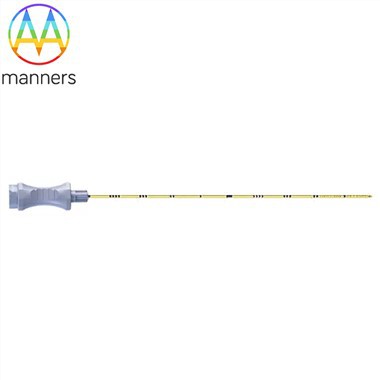
All assemblies are machined from medical-grade stainless steel, with necking, swaging, grinding, laser cutting, laser marking, and electropolishing controlling concentricity, tip sharpness, lumen finish, and depth legibility. The Mick type needle architecture is well matched to AI-generated plans because each function is separated: a sharp trocar-point obturator for entry, a ground-beveled echogenic canula tip for verification, and a honed hub canula so the strand transfers exactly as the plan specifies.
Step-by-Step AI-Assisted Workflow
First, acquire imaging - mpMRI with or without PSMA PET/CT - and run automated segmentation, then review and correct contours manually; no program should accept unverified auto-contours for a definitive implant. Second, define objectives explicitly: coverage target, urethral and rectal constraints, and an acceptable track count. Third, generate the AI plan and inspect not just the dose metrics but also the track geometry, asking whether each track is physically achievable given pubic arch anatomy and gland position.
Fourth, convert the plan to a grid template and flag any track requiring a custom needle or oblique approach. Fifth, in the room, place tracks with real-time confirmation, verifying depth at intervals rather than only at the endpoint. Sixth, perform intraoperative dosimetry where available and compare against the AI-predicted distribution; deviations should be corrected immediately. Seventh, complete post-implant dosimetry and feed the result back to the planning team so model performance can be audited against delivered dose.
What Early Adopters Report
Centres that have implemented AI-assisted planning describe three consistent benefits. Planning time falls substantially, freeing physicist capacity and allowing more optimization cycles rather than fewer. Plan quality becomes more consistent between planners, because objectives are explicit rather than tacit. And complex cases - large glands, prior radiation, salvage settings - become tractable, since the optimizer explores configurations a human would not enumerate.
The reported difficulties are equally instructive. Automated plans sometimes propose track geometries that ignore practical constraints, requiring a human-in-the-loop veto. Plans that push urethral constraints to their limit leave no tolerance for placement error, which makes needle accuracy the new bottleneck. Teams also note that AI output is only as good as its imaging input, and that registration error between MRI and ultrasound can erase the predicted benefit. The practical conclusion from early adopters is that AI planning raises the value of hardware precision rather than substituting for it.
Commissioning an AI planning tool deserves the rigour applied to any planning system. End-to-end tests should run a phantom case through segmentation, optimization, and track generation, then verify that the delivered distribution matches the prediction within a stated tolerance. Version control matters just as much: a model update can change track recommendations without changing the interface, so the team should record the model version alongside the plan, exactly as it records the planning system version.
Governance questions remain open. An automated plan is a proposal, and clinical accountability stays with the treating team, which means review must be substantive rather than formal. Documentation should state which objectives were optimized, whether any were relaxed, and why. Programs that can answer those questions for every case will adopt AI planning safely; programs that accept output without interrogation will accumulate plans that nobody can defend when an audit arrives. Recording who reviewed the plan, and what they changed, is the cheapest safeguard available.
Practical Takeaways for Planning Teams and Buyers
First, treat automatic contours as a draft and budget time for review. Second, express objectives numerically and document them, so plans are reproducible. Third, examine track geometry before accepting a plan, and reject configurations that cannot be physically achieved. Fourth, specify needles with laser-marked depth scales and verified echogenic tips if AI plans are used routinely, because those plans assume precise execution. Fifth, retain a small inventory of larger gauges and custom lengths for oblique or high-density tracks. Sixth, close the audit loop with post-implant dosimetry and compare against predicted distributions.
Where AI-Assisted Planning Is Heading in 2026
Three trajectories are visible. The first is integration of PSMA PET into automated planning, so that biological target volumes propagate directly into track selection. The second is real-time intraoperative optimization, where the plan is updated as tracks are placed rather than generated entirely preoperatively. The third is coupling with robotic or semi-robotic insertion platforms, in which the plan is transmitted as coordinates and the machine holds the trajectory - a development that only works if the needle assembly is dimensionally consistent from unit to unit.
For suppliers, the message is that consistency is the product. An assembly that varies in straightness, bevel angle, or lumen friction undermines an algorithm that assumes repeatability, while a documented, drawing-controlled assembly becomes an enabler of automated planning.
Conclusion
AI-assisted planning does not replace the implant team; it relocates the difficulty. Once the dose distribution can be optimized quickly, the limiting factor becomes whether the hardware can deliver that distribution to within a millimetre, in a gland that moves with every pass. A brachytherapy needle for cancer treatment used in an AI-assisted program must therefore be specified like an instrument: concentric cannula, sharp trocar point, ground-beveled echogenic tip, honed hub, legible depth marking, and the gauge range needed to realize whatever loading density the optimizer proposes. Programs that align device tolerance with algorithmic ambition will capture the dosimetric gain; programs that do not will find that their plans are better than their implants.
< img alt="news-1-1" src="/uploads/24240/news/202604241539186d0ff.png " />