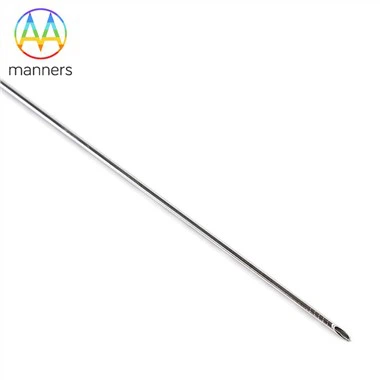
15 Gauge 25mm Intraosseous Needle For Pre-Hospital Emergency Care
Nov 20, 2026
Pain Point
Pre-hospital resuscitation is often carried out in uncontrolled environments, including roadside accidents, out-of-hospital cardiac arrest and field mass casualty incidents. Emergency providers frequently struggle with failed peripheral venous access. This difficulty is amplified among obese patients. Thick subcutaneous adipose tissue obscures bony landmarks that clinicians rely on to locate intraosseous insertion sites. Standard-length intraosseous needles cannot reach cortical bone when soft tissue depth exceeds their effective working range. Unlike in-hospital settings, pre-hospital teams rarely have immediate ultrasound support to measure tissue thickness. When resuscitation medications, crystalloids or blood products cannot be administered quickly, the window for saving lives closes rapidly. Many emergency medical service stock kits only carry short or standard intraosseous needles, leaving no appropriate option for patients with thick soft tissue. This creates a critical equipment gap, which the 15 Gauge 25mm intraosseous needle is designed to fill. Without this extended-length option, first responders face avoidable rescue failure in high-BMI critical patients.
Working Principle
The intraosseous route leverages the non-collapsible marrow venous plexus inside long bones. Even under severe hypotension and circulatory collapse, marrow vasculature remains patent and connects directly to the systemic venous circulation. Once the 15 Gauge 25mm intraosseous needle penetrates skin, fat and cortical bone into the medullary cavity, infused agents rapidly enter central circulation with pharmacokinetic performance comparable to central venous access. Its core design specification sets a clear safety threshold: the safe maximum skin-to-cortex depth is 20 mm, reserving 5 mm of needle cannula seated inside the marrow space. This 5 mm buffer prevents over-advancement and posterior cortical perforation, while anchoring the needle stably to reduce dislodgement risk. The 15 Gauge stainless steel cannula balances high infusion flow and mechanical strength. Stainless steel resists bending under rotational insertion force when passing through dense fatty layers, a key advantage in pre-hospital rough operating conditions.
Device Classification
Intraosseous needles can be grouped by insertion mode, dimension and clinical scenario. Manual intraosseous needles rely on hand rotation and axial pressure; they are lightweight, battery-free and perfectly suited for pre-hospital EMS bags. Powered intraosseous systems use drill-style drivers, which lower operator fatigue but require charged batteries and extra storage space. By effective length, short needles (below 18 mm) are reserved for pediatric patients and lean adults with minimal overlying soft tissue. Extended-length models such as the 15 Gauge 25mm intraosseous needle target patients with skin-cortex depth up to 20 mm. Manufacturers also accept custom development: gauge, tip geometry and overall length can be modified based on customer 2D drawings, 3D files or physical samples. As injection and puncture instruments, these needles follow strict sterile production rules. Packaging options cover standard export cartons or customized sterile packs as requested by distributors and medical institutions.
Practical Operation Guide
Before insertion, quickly evaluate the patient's indication and body habitus. Candidates include cardiac arrest, severe shock and critical illness with repeated IV failure. Preferred insertion site for pre-hospital use remains the proximal tibia, as landmarks are easier to palpate than the humeral site. Estimate soft tissue thickness over the target site. Only select the 15 Gauge 25mm intraosseous needle if the estimated skin-to-cortex distance does not exceed 20 mm. Clean the skin rapidly with antiseptic solution and stabilize the limb firmly to avoid unexpected movement during penetration. Hold the needle perpendicular to the bone surface, apply steady axial pressure with rotating motion until a distinct "give" sensation confirms cortical penetration. Stop advancing immediately. Remove the inner stylet, aspirate marrow to verify intraosseous positioning, then flush with normal saline to rule out extravasation. Secure the hub with sterile dressing and immobilize the limb. Strictly avoid this needle at sites with fracture, local cellulitis, osteogenesis imperfecta or recent intraosseous attempts.
Real-World Clinical Experience
Field EMS crews have accumulated practical insights after adding the 15 Gauge 25mm intraosseous needle to their rescue inventory. The most obvious benefit is higher first-pass success in obese patients where standard needles previously could not reach bone. Operators highlight that the 15 Gauge lumen delivers faster fluid resuscitation, which matters greatly for traumatic hemorrhage and septic shock in the pre-hospital phase. One widespread mistake is automatic selection of this extended needle for every obese patient. Some obese patients still have thin soft tissue over the tibia, and an overly long needle raises perforation risk. Without ultrasound, palpation-based depth estimation carries inherent uncertainty. Crews are advised to document every intraosseous attempt, site condition and any signs of extravasation for continuous quality improvement. It is also important to communicate clearly with receiving hospital teams that an extended-length intraosseous device has been placed.
Summary & Reflection
The 15 Gauge 25mm intraosseous needle is a purpose-built emergency tool that extends the usable boundary of intraosseous access for pre-hospital care. Its 20 mm usable depth plus 5 mm safety margin provides a predictable safety framework for thick soft tissue cases. It is not a universal replacement for shorter intraosseous needles or peripheral IVs; it serves as a targeted backup option in the layered vascular access algorithm. Equipment alone cannot eliminate risk. Operator familiarity, rapid patient assessment and recognition of contraindications remain irreplaceable. Many EMS teams purchase the needle without updating their local protocols, which limits its clinical value. Standardized pre-hospital decision trees for needle selection should be rolled out alongside equipment procurement.
Outlook & Recommendations
Moving forward, manufacturers may print clear depth markers on the cannula shaft to help field operators judge insertion progress without ultrasound. Matching compact auxiliary training phantoms for the 15 Gauge 25mm intraosseous needle can be supplied together with bulk orders. EMS authorities should revise pre-hospital resuscitation guidelines to include extended-length intraosseous devices and define clear indication criteria. More out-of-hospital observational research should collect complication and success-rate data focused on obese patients. Suppliers should maintain flexible custom machining capacity while guaranteeing consistent sterile packaging for global emergency supply chains. As overweight and obesity prevalence rises globally, extended intraosseous needles will become a standard component of modern pre-hospital emergency kits.