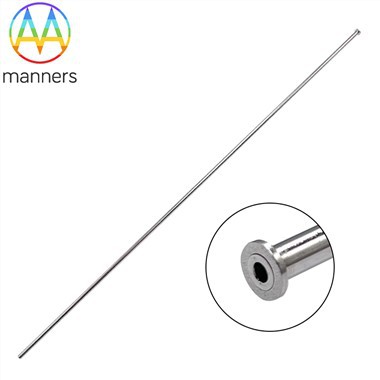
Clinical Principles and Application Value Perspective | Technical Mechanism, Clinical Scenarios of Menghini Liver Biopsy Needle and Product Implementation by Manners Technology
May 12, 2026
Clinical Principles and Application Value Perspective | Technical Mechanism, Clinical Scenarios of Menghini Liver Biopsy Needle and Product Implementation by Manners Technology
The Menghini Liver Biopsy Needle, invented in 1958 by Italian pathologist Giorgio Menghini, is a dedicated interventional biopsy device. Based on the principle of negative‑pressure aspiration sampling, it has become the most widely used standardized needle in the field of global liver histopathological diagnosis, as well as an irreplaceable core consumable for liver disease diagnosis, liver fibrosis grading, and differential diagnosis of benign and malignant tumors. Compared with other biopsy systems such as Tru‑Cut and VABB, the Menghini needle features simple operation, continuous sampling via a single puncture, minimal trauma and a low complication rate, making it a standard configuration in the gastroenterology, hepatology and interventional departments of hospitals at all levels. As a manufacturer with full‑chain customization and precision manufacturing capabilities, Manners Technology is driving the standardization and localized implementation of this product in global clinical settings.
The core technical mechanism of the Menghini needle lies in the coupling of negative‑pressure aspiration and cutting edge shearing. After puncturing into the liver parenchyma, an external negative‑pressure device creates an intraluminal vacuum, which draws the target liver tissue into the needle lumen. The sharp cutting edge at the needle tip then severs the tissue and retains the sample, enabling acquisition of sufficient and intact tissue specimens with a single needle pass. This avoids risks such as bleeding, bile leakage and liver capsule laceration caused by repeated punctures, and significantly reduces intraoperative pain and postoperative complication risks for patients. In terms of clinical indications, the device covers pathological confirmation of nearly all liver disorders, including liver cirrhosis, fatty liver, viral hepatitis, primary/secondary liver tumors, as well as hepatic infiltration of leukemia and lymphoma. It serves not only as the gold‑standard supporting device for liver fibrosis staging assessment, but also as a critical tool for the diagnosis of drug‑induced liver injury and autoimmune liver diseases.
Manners Technology thoroughly addresses clinical pain points by optimizing product performance and scenario adaptation around the core functions of the Menghini needle. In structural design, while strictly replicating the classic Menghini configuration, the company optimizes the concentricity of the needle tube, sharpness of the cutting edge and negative‑pressure tightness to ensure sampling success. In terms of specifications, parameters such as length, outer diameter and wall thickness can be adjusted according to patients' body types, puncture approaches and sampling depths, meeting differentiated clinical needs for adults, children, emaciated or obese patients. Clinical feedback generally indicates that the negative‑pressure stability of a high‑quality Menghini needle directly determines sample integrity. Through precise tolerance control, Manners ensures no negative‑pressure leakage and no tissue slippage, substantially improving the accuracy of pathological diagnosis.
From an industry development perspective, liver biopsy is an essential examination for the diagnosis and treatment of liver diseases. The continuously growing global patient base with chronic liver disease, fatty liver and liver tumors drives steady expansion of the Menghini needle market. The high‑end segment was long monopolized by European and American brands; however, Chinese manufacturers represented by Manners Technology have achieved performance alignment with international standards through independent precision manufacturing and clinical customization capabilities, breaking reliance on imported products. With the popularization of precision medicine and minimally invasive interventional technologies in the future, Menghini liver biopsy needles will further evolve toward ultra‑fine specifications, safety‑protected designs and ultrasound‑visualization compatibility. Manufacturers' clinical scenario responsiveness and customized R&D speed will become core competitive barriers.